Buying a Car – Know the Worst Car Buying Mistakes

Buying a car comes with extreme highs and lows. On the one hand, you have the freedom to travel wherever your heart desires, and everyday trips to work are now a breeze, but on the other hand, you now have to navigate vehicle maintenance, petrol, insurance, and monthly car payments for your new set of wheels.

Before coughing up and driving off, consider going through these car-buying tips and insights to avoid making car-buying mistakes that could cost you thousands.

Let’s get straight into it.

In this article, you will:

  • Learn what car-buying mistakes to steer clear of
  • Explore the basics of buying a car
  • Weigh the pros and cons of buying a new or used car
  • Discover the benefits of installing a vehicle tracking device
  • Understand why Cartrack is the perfect vehicle tracking company for your new car

Thinking about those first or next set of wheels?

Found yourself thinking about buying your next or first car lately? Before you embark on test drives and dealership negotiations, buckle up and equip yourself with some essential knowledge.

This crash course on car buying will navigate you through the twists and turns of getting the perfect buy without experiencing any bumps on the road.

The worst car-buying mistakes

Steering clear of common car-buying blunders is crucial for a smooth purchase experience. To avoid getting lost in a maze of bad decisions, here are the top five mistakes to avoid:

  1. Focusing only on monthly payments
    ‍
    When looking at your budget to assess if you can afford to buy a new car, don’t just concentrate solely on how much you will pay each month. Negotiating the overall vehicle price and financing terms separately is key to avoiding a higher overall cost.
    ‍
  2. Letting emotions drive decisions
    ‍
    ‍
    Falling in love with a particular model might lead to overpaying. It’s crucial to stay practical, do research, compare models, and ask yourself if the vehicle matches what you need and what you can afford.
    ‍
  3. ‍Skipping the test drive
    ‍
    Don’t judge a book by its cover, or, in this case, a vehicle by its design. Get in the driver’s seat and see what else the vehicle has to offer. The test drive is vital to ensure the chosen vehicle meets expectations and to prevent any surprises post-purchase.
    ‍
  4. ‍Overlooking used car inspections
    ‍
    When buying a used car, don’t always take the dealer’s word as fact. Get a trusted mechanic to further inspect the used vehicle. It is important to catch potential issues and avoid unexpected expenses.
    ‍
    ‍
  5. Lack of research
    ‍

    Not visiting and comparing other dealerships or delving enough into the vehicle itself, like the pricing and financing options, can all lead to overpaying and making uninformed decisions.
    ‍

Now that you know what not to do when getting a car, let’s rewind to some car-buying basics and teach you all you need to get your new car off the lot and into your garage.
‍

‍Buying a car: 101‍

Acquiring a car is a decision one should take seriously, some take months contemplating the make, model, year, diesel or petrol and so much more. Before deciding on the popular brand out right now, consider asking yourself these questions:
‍Buying_a_car_101

When is the best time to buy a car?

The answer to this might vary depending on where you are in the world. In South Africa, there are various trends that car buyers follow to find the right vehicle at the right price, like sales promotions, new model launches, and holiday trends.

Motorists often follow the seasonal sales at the end of the year. Between October and December. Many dealerships push to meet annual sales targets during this period, offering discounts and promotions on both new and used cars.

Similar to seasonal clothing sales, when a car manufacturer introduces a new model, dealerships also often slash prices on older models to make space for the latest release. This allows you to enjoy reduced prices, just like snagging discounts during a fashion sale.

If you can’t afford to wait months for the prices to cheapen up, you can visit the dealerships midweek on a Monday or Tuesday. Most dealerships are not as busy during the week, so you can take advantage of the low sales and strike up a deal.
‍

What are your needs?

Finding the perfect car involves thoughtful consideration of various factors like financial planning, lifestyle preferences, and car features to ensure your choice aligns seamlessly with your priorities and, most importantly, your wallet.

  • Financial planning: Think about what you can comfortably afford, not just for the car but also for insurance, fuel, and upkeep. Set a budget limit and stick to it.
    ‍
  • Lifestyle and requirements: Are you a city driver or someone who loves weekend trips? Consider what you need for daily life and plans, like space for the family or golf clubs, or maybe both.
    ‍
  • Car features: First, focus on important things like safety and reliability. Then, think about extra stuff like fancy tech or comfort. Usually, the more extras you want, the more it’ll cost, right? But if you want extra features from an affordable car, then buying a used vehicle with all the extras already included at a low price would be a big benefit.
    ‍‍‍ 

What are the first steps of buying a vehicle?

When it comes to choosing your ideal vehicle, it’s all about informed decisions and hands-on experiences. Here’s how to navigate the process seamlessly:

  • Do the research: Look up trusted brands online, learn as much as you can about the different types of vehicles, and ask around amongst your peers about their opinions.
    ‍
  • Explore: After reading articles and brand pages, your work is not yet finished. Visit dealerships, check online listings, and consider used cars for potentially better deals. If you’ve made your choice and have a specific car in mind, set up a test drive and experience driving the vehicle.
    ‍
  • Get a quote: If you think you’ve found the one, get a quote for the car from different dealerships and online car-selling platforms to compare prices and finance options.
    ‍

Did you read the fine print?

It is time to “cross the ‘t’s and dot the ’i’s.” When it comes to paperwork, you must understand the small details. Take a closer look at the following:
‍

  • Insurance: Once your vehicle is on the road, its value decreases, and various issues like windscreen damage or hijacking can happen. Having insurance is crucial for protection. Select the coverage that fits your requirements and pocket.
  • Maintenance package: Think about a maintenance plan that suits your vehicle’s requirements and usage. Invest in an extended warranty or maintenance package to enhance your vehicle’s well-being, ensure its longevity, and possibly reduce future repair expenses.
    ‍

New or used?

Deciding between a new or used vehicle can be a tough call, with each option offering unique advantages and drawbacks. To help you navigate this important choice, let’s list out things to look out for each alluring option.

Pre-loved cars Brand new cars
Price Generally, it costs less upfront and might be negotiable. Higher initial cost, but the potential for incentives.
Depreciation Loses value more slowly over time. Rapid loss of value, especially in the first years.
Safety Depends on the condition of the vehicle and how old the vehicle is. Depends on the model, but should have the latest standard safety features, like emergency braking and lane departure warnings.
Insurance rates Often come with lower insurance premiums. Higher insurance costs due to the car’s new value, make, model and colour.
Variety More choices are available in the used vehicle market, from old to relatively new models. Have access to the latest models but sometimes new cars are not readily available, especially for high-end cars, so drivers have to be on a waiting list.
Condition May have some wear, tear and potential issues. New vehicles have no history of accidents or wear and tear. They also come with a maintenance warranty.
Customisation Modifications may already be done or available. Full range of customisation options from the start.
Warranty coverage Depending on the age, there might be limited or no warranty left. But some dealerships can provide a maintenance warranty at a cost. Typically comes with a comprehensive warranty of around 3-5 years or 100,000 km, whichever comes first.
Financing rates Higher interest rates for used car loans but lower total car costs. Lower interest rates for new car loans but higher overall vehicle cost.


How do you tell if a used car is a good buy?

If, after reviewing the list, you find yourself leaning more towards getting a pre-owned vehicle that matches your current needs and budget. It’s good to keep in mind that since these vehicles aren’t brand new and shiny, there are some additional precautions to consider to ensure the car you choose doesn’t have any hidden dents or extra expenses.

  1. Maintenance record
    ‍
    See if there’s a history of regular check-ups from a trusted garage. This tells you the car was looked after. If you can’t find these records or they’re not consistent, it might mean the car wasn’t well taken care of or has some hidden issues that might cost you in the future.
    ‍
  2. Hidden damagesDon’t just focus on the shiny leather and fresh car smell. Check the car thoroughly for dents, scratches, and rust, especially in hidden spots. When you take it for a spin, pay attention to any strange sounds or handling issues.Tip: If you see different paint colours or uneven body parts, it could mean the car had some fixes done. Ask the seller directly about any past accidents and get records if they have them.
    ‍
  3.  Inspect the interiorLook for signs of wear like worn-out seats, ripped upholstery, and electronics that don’t work right. Test everything – the air conditioning, radio, power windows – to make sure they’re in good shape. Keep an eye out for weird smells or stains, which might mean there’s been water damage or other problems.
    ‍
  4. Mileage‍Think about how much the car has been driven. Lots of miles don’t always mean it’s a bad car, but it might need more fixing. Compare it with the maintenance record to be sure.
    ‍
  5. VIN checkMake sure the car’s VIN (vehicle identification number) matches the documents. Use a VIN check service to find out if the car was in any accidents or had other issues. Always double-check that identification number if the VIN doesn’t match, it might mean the vehicle has been stolen.
    ‍
    You can learn a lot about a car’s history by checking out its previous owners and the reason why it was sold. An extra precaution to consider is to look up how many owners the car has had. The manual should provide this information, but the dealer should be able to provide it as well.
    ‍
How_do_you_tell_if_a_used_car_is_a_good_buy

Get a tracking device for your new vehicle‍

So you’ve chosen the vehicle and you’re happy with your purchase. The next mission to tackle is security; get yourself a vehicle tracking device.

These days vehicle theft is as common as vehicle buying. It is an unfortunate reality, and ensuring a car’s safety is a top priority for most motorists. In these cases, a vehicle tracking device is more than just an optional accessory — it’s a proactive measure to safeguard your valuable asset.

Most new cars at the dealership today are already fitted with a tracking unit to help you protect your investment. All you have to do is become an official client of that tracking company.

Benefits of a tracking device

Besides all the safety features a vehicle tracking unit comes with, it also provides a big advantage in terms of insurance. Insurance companies like vehicles with tracking units because they make it easier to recover stolen cars quickly. This not only lowers the risk for insurers but might also score you some discounts or lower premiums if you go for this extra security measure.

Let’s see other benefits that come with installing a vehicle tracking device.
‍

  1. Safety and security
    ‍
    – Decreased risk of theft: Without tracking, a stolen car is much harder to recover. With tracking devices installed, they can alert you in real time and assist police in locating your vehicle.- Emergency assistance: If you’re stranded or involved in an accident, you can use the provided mobile app to receive emergency assistance, or if the tracking unit has crash detection and you are involved in an accident, then the company will be notified of the event and send emergency assistance to your location.- Able to prove innocence: In the case of false accusations or hit-and-run incidents, proving your location and driving behaviour history through your GPS device can assist in validating your innocence.
    ‍
  2. Peace of mind and convenience
    ‍
    – Precise driver monitoring: Stay informed about your vehicle’s location and usage. For instance, when your teenager is behind the wheel, track their adherence to safe driving practices.- Reduced anxiety and stress: Eliminate uncertainty by always knowing your car’s whereabouts, even during nighttime journeys or on unfamiliar routes.
    ‍
  3. Financial aspects- Lower insurance premiums: As mentioned above, some insurance companies offer discounts for cars with tracking devices due to the lower risk of theft and fraudulent claims.
    ‍
    – Potential depreciation impact: Cars without tracking might be less desirable to future buyers, impacting resale value.- Costs associated with recovery: In case of theft, without tracking, recovery efforts can be time-consuming and very expensive, especially if the vehicle cannot be found and you have to potentially buy a new vehicle.
    ‍

Choose the right tracking unit for your new vehicle

Searching for a trusted GPS unit is as easy as opening your search engine and looking for the most reliable and proven vehicle tracking company. Among the many companies that present themselves, there is one that has one of South Africa’s highest stolen vehicle recovery rates — Cartrack.

Install a Cartrack tracking device on your new vehicle and enjoy these benefits:

To sweeten the deal, Cartrack offers quality value-added services:
‍

  • CarWatch: This acts as an early warning system that you can activate through our mobile app. Once activated, it alerts Cartrack if your parked vehicle is moved without your knowledge.
    ‍
  • Protector: Provides 24/7 professional roadside assistance when you press the button on the Cartrack app. This service covers battery jumpstarts, tyre changes and car towing. Plus Legal assistance and emergency or accident services if needed.

Give your new car that extra layer of security you can trust with Cartrack’s vehicle safety solutions. Join over 1,9 million other happy Cartrack customers worldwide and put your vehicle’s protection first.

Get your free installation today.
Vehicle Inspection – Digitise Your Daily Fleet Inspection With A Powerful App

Vehicle inspections can be daunting without a fleet monitoring system in place. Why wait for scheduled, time-consuming inspections to know your fleet’s health when there’s an easier way to keep track of it daily?

Ignorance is bliss, but not when it comes to your fleet’s vehicle health. Poorly maintained vehicles lead to unplanned downtime, increased fleet costs, and worse, driver safety risks.

Here’s how you can gain 360-vision of your fleet fleet’s health with a digitised vehicle inspection system.

In this article, you will:

  • Learn what vehicle downtime is
  • Discover the risk of not conducting vehicle inspections
  • Find out why digital inspections are the future of fleet management
  • Uncover how you can elevate your fleet vehicle inspections with Cartrack Malawi

What is vehicle inspection?

Vehicle inspection is a procedure mandated by the government to ensure that vehicles conform to established safety and emission standards. It entails a comprehensive scrutiny of a vehicle’s components, functionalities, and adherence to said standards, ensuring the safety and reliability of your vehicles.

This comprehensive assessment encompasses an array of components and systems within the vehicle, from brakes and tires to the exhaust system and the engine. Each of these elements needs to go through extensive scrutiny to ensure they are functioning at their optimum level. Vehicle inspection ensures that fleet managers are always aware of the state that their vehicles are in.

Why is vehicle inspection so important for fleets?

As a fleet manager, you are aware that regular vehicle inspections are essential for keeping your fleet vehicles running effectively and safely. Vehicle inspections are a trackable indicator of the state of your fleet vehicles. Regular inspections help you proactively identify problems with your vehicles, allowing you to rectify any existing or potential mechanical issues.

Here are some of the reasons why vehicle inspection is so important:

  • It promotes safety on the road: Vehicle inspection helps you identify any potential issues in the vehicle that can cause accidents and other safety risks. An example of this is brake failure. According to the National Road Safety Strategy (NRSS), brake failure is the second most significant mechanical cause of car accidents on South African roads, accounting for 11.4% of all car accidents.
    ‍
  • It prevents unplanned downtime: Maintenance concerns that are left unattended can lead to unplanned downtime. By quickly identifying maintenance needs, vehicle inspection helps you spot potential issues before they become serious and lead to temporary or permanent downtime.
    ‍
  • It increases driver productivity: Regular inspections translate into decreased downtime, meaning that drivers can stay on schedule and complete all of their tasks with little to no delays. Also, well-maintained vehicles, due to regular inspections, operate more efficiently, which allows for faster task completion.
    ‍
  • It maximises fleet vehicle lifespan: Regular inspections help extend a fleet’s lifespan as potential problems are identified quickly before they turn into a more serious issue This reduces the need for premature replacements, allowing you to get the most out of each vehicle.
    ‍
  • It boosts cost savings: Regular inspections can lead to lower maintenance costs by identifying and addressing issues before they become significant, expensive problems.
Why_is_vehicle_inspection_so_important_for_fleets

What’s at risk if you don’t inspect vehicles?

Not conducting vehicle inspections can pose significant risks, affecting both safety and legal compliance. Here are a few risks any fleet manager would desperately want to avoid:‍

  • Increased accident risks: By failing to properly inspect vehicles, the risk of accidents occurring is increased. This leads to financial repercussions that can negatively impact the running of the fleet.
    ‍
  • Unplanned downtime: When you don’t frequently inspect vehicles, it leads to unplanned downtime, which not only disrupts schedules but also affects the productivity of your fleet.
    ‍
  • Poor maintenance and safety: Lack of effective inspection leads to poor maintenance of vehicles, which increases the risk of mechanical failures and safety hazards on the road.
    ‍
  • Non-compliance and fines: When vehicles aren’t inspected, a fleet may fail to meet regulatory standards, leading to non-compliance fines and penalties. This negatively impacts the fleet’s finances and reputation.

What is the difference between fleet inspections and preventative maintenance?

You might be thinking that fleet vehicle inspections and preventative maintenance sound fairly similar. Well, you’d be right. While they may fall into the same bracket, there are a few key differences that distinguish them:

Fleet Vehicle Inspection Preventative Maintenance
Definition Procedures designed to ensure vehicles meet safety standards and regulations Procedures designed for the proactive, periodic upkeep of vehicles to prevent breakdowns
Focus Safety and roadworthiness of a vehicle Preventing unexpected vehicle failures and unplanned downtime
Frequency Inspection can be frequent (e.g., daily or weekly) Maintenance is typically scheduled based on vehicle usage and fleet schedule

One thing that joins these two aspects of fleet vehicles together is the technological advancements that simplify them. This has led to the implementation of digital vehicle inspection.

What is digital vehicle inspection?

Digital vehicle inspection (DVI) is a process that makes use of digital technologies to inspect vehicles and maintenance processes in the fleet industry. This digital version of vehicle inspections uses digital tools and software to conduct accurate and efficient vehicle inspections.

By replacing traditional paper-based inspection methods such as paper-based checklists and manual vehicle inspections, digital vehicle inspections allow technicians to perform, document, and communicate vehicle inspection findings more efficiently and accurately.

What are the key components of an effective digital vehicle inspection system?

  • Compatible mobile device or tablet: Digital vehicle inspection software should be available for use on mobile devices or tablets. This eliminates the need for paper checklists and enables real-time data entry and reporting.
    ‍
  • Checklists: Digital vehicle inspection software should provide standardised and customisable inspection checklists and templates that cover various aspects of vehicle health, including engine, brake, tyres, and vehicle fluids. These checklists are tailored to the different vehicles being used, along with inspection purposes.
    ‍
  • Communication tools: Digital vehicle inspection systems must be able to generate comprehensive reports that are easily shareable amongst managers and drivers.

8 reasons you should consider digitising your fleet’s vehicle inspection process

In a world where everything is going digital, making your fleet vehicle inspections as paperless and seamless as possible, is something worth considering, here are 8 reasons why:

  1. It saves time and frees up resources: Digital vehicle inspection streamlines the inspection process by digitising it. This enables inspection data to be captured in real time, and instantly transmitted to a centralised database. This means faster reporting, quicker decision-making, and reduced administrative time, freeing up resources for more pressing tasks within the business
    ‍
  2. It improves data quality and accuracy: By making use of standardised checklists and real-time data capture, digital vehicle inspection ensures that all essential components of vehicle inspection are systematically checked, reducing the chances of oversight and human error associated with manual data entry.
    ‍
  3. It enhances security and accessibility: Digital vehicle inspection minimises the need to physically store documents, a process that can result in the loss or damage of forms. By facilitating the real-time transfer of information, it ensures seamless accessibility to essential inspection documents and data from any location.
    ‍
  4. It enhances communication: Digital vehicle inspection systems provide real-time access to inspection results and reports, which enables immediate communication of findings to fleet managers and drivers. This open communication streamlines collaboration and ensures timely action on potential.
    ‍
  5. It reduces fleet expenses: By streamlining inspections, reducing errors, and improving communication, digital vehicle inspections lead to increased cost savings by reducing labour costs, and maintenance costs, and improving asset utilisation.
    ‍
  6. It improves preventative maintenance: Digital vehicle inspection can analyse historical inspection data to identify vehicle patterns and trends, enabling preventative maintenance practices. This proactive approach can help prevent unexpected breakdowns, reduce repair costs, and extend your fleet’s lifespan.
    ‍
  7. It enhances driver safety: This data-driven approach collects day-to-day information on drivers and fleet vehicles, making it easy to quickly identify and address potential vehicle issues as soon as possible. This translates to fast, proactive intervention, which helps enhance driver safety by reducing the risk of accidents.
    ‍
  8. It encourages data-driven decision-making: Digital vehicle inspection enables the centralised storage of inspection data in digital systems. This enables fleet managers to gain valuable insights into vehicle performance, maintenance trends, and potential areas for improvement. This ensures that they can make data-driven decisions to optimise your fleet operations.

Unlock the benefits of digital vehicle inspection with Cartrack Malawi

Cartrack Malawi helps businesses access digital vehicle inspections through its automated maintenance scheduling plan, also known as preventative maintenance.

benefits_of_digital_vehicle_inspection

How does Cartrack’s preventative maintenance work?

Our preventative maintenance plan makes use of engine diagnostics, hours of vehicle utilisation, and the time of the last service to predict when your vehicles need servicing. This helps businesses extend their vehicle’s lifespan and reduce maintenance costs.

The platform integrates with various systems, working to not only automate processes but also customise operations. This integration reduces repetitive admin tasks, allowing all team members (drivers and fleet managers alike) to easily access or upload information from one easy-to-use platform.

4 benefits of having a preventative maintenance plan in your business

Cartrack’s preventative maintenance plan is designed to help businesses manage their fleets more effectively, avoid unexpected downtime, reduce maintenance costs, and increase the longevity of their vehicles. It can do this by helping you:

  1. Gain access to real-time alerts: Cartrack can provide businesses with real-time alerts of any vehicle issues, including engine faults, worn brake pads, oil and water fluctuations, and other diagnostics. This is a crucial part of helping fleet managers quickly preempt which vehicles require servicing. Not only does this prevent unplanned downtime, but also helps you see which of your vehicles will be out of service and when they’ll be available again, ensuring you don’t overbook and under-deliver.
    ‍
  2. Build a seamless, automated maintenance plan: Cartrack’s platform can automate the maintenance schedules for each of your fleet vehicles by using utilisation hours and the time of the last service. You can use this to warn your drivers of scheduled maintenance on equipment they utilise in advance, helping keep workflows undisrupted. By enabling a hassle-free maintenance and servicing routine, you prevent driver frustration, ensuring that they aren’t left stranded with no equipment to complete jobs. If equipment isn’t available, you are then able to assign new tasks or vehicles to drivers who may be impacted.
    ‍
  3. Obtain customisable reports: Businesses have the option of choosing from hundreds of powerful reports or getting customisable reports that are tailored to their specific needs, and sent to their inbox. This ensures fleet managers have all the information they need at their fingertips. These reports enable businesses to analyse various aspects of their fleet operations (including engine performance, fuel consumption, vehicle utilisation, and vehicle location) to optimise their fleet management and ensure they’re not faced with unplanned and surprised downtime.
    ‍
  4. Receive automated maintenance reminders: Never miss a maintenance appointment with Cartrack’s automated servicing reminders, helping fleet managers stay on top of their vehicle maintenance game. By using real-time vehicle diagnostics to establish effective maintenance plans, our software sends automated reminders reminding fleet managers that vehicles need to go in for maintenance checks. This helps fleet managers effectively plan for servicing, which minimises unplanned downtime and enables direct communication with drivers.

What’s so incredible about these benefits is that they’re all easily accessible via our app. Talk about convenience, right?

Enter into a digital era of vehicle inspections with Cartrack Malawi

The world of fleet management is constantly evolving, and with the digitisation of vehicle inspection, you don’t want to be left behind. Unlock time savings, improved driver safety, and reduced fleet expenses for your fleet in a few simple steps.

‍Contact Cartrack Malawi today and say goodbye to paperwork, admin, and human error in your vehicle inspection process.

Powerful Benefits of the Right Vehicle Tracking System for Business

There’s more to managing a fleet than just tracking vehicles from A to B – look at the bigger picture. Reliable vehicle tracking software can help you easily oversee a large group of vehicles, optimise management operations and drastically reduce fleet costs.

It’s time to make the overwhelming weight every fleet manager carries a whole lot lighter.

Vehicle tracking systems explained

Vehicle tracking is the technology that keeps you informed of your vehicle’s whereabouts at all times, increasing its safety. Thanks to satellites, signals, and a tracking unit, you get a global GPS tracking system that can pinpoint the exact geolocation of your mobile assets at any time. Simply being able to view the live status and location of your vehicles in real time is a huge win.

Manually managing a large fleet of vehicles is often a daunting task. Luckily, with location-based technology, fleet managers can receive interactive and analytical reports in real-time and gain an advantage from using smart tracking solutions.

So, what is location-based technology? It’s GPS – aka a global positioning system. It’s used to track trucks, cars, and other mobile assets you own, like generators, trailers, and cement mixers, all via a tiny GPS tracking unit installed in a discrete location on the company asset.

A tracking unit offers a variety of advantages for fleet managers and their businesses, such as:

  • Seeing the exact location of vehicles in their fleet
  • Reducing the threat of vehicles being stolen
  • Increasing the chances of stolen vehicle recovery
  • Knowing exactly who is driving your vehicles and how they are driving them
  • Assuring your fleet remains within authorised locations
  • Increasing productivity through task management

More than locating your assets, GPS units ensure vehicles are used properly and are left in safe locations when not in use. In the event of vehicle theft, this GPS equipment often ensures its safe return.

So, how are vehicles tracked?

The GPS technology we just discussed above is a satellite-based radio navigation system that relies on ground stations, satellites and receivers to provide real-time data such as a vehicle’s:

  • Live location
  • Distance travelled
  • Travelling speed
  • Time and direction

The data is instantly transmitted using a cellular or wireless network.

This sort of technology is mainly used to increase the security of vehicles and is effective for the smooth functioning of fleet operations. It helps businesses save money and reduce dangerous driver behaviour like speeding or harsh braking.

Knowing the types of drivers in your business also helps, as employing safe drivers can lead to lower vehicle repair costs, which can in turn increase commercial profits and make your business run more efficiently, while reckless ones need further training or management and contribute to increased fleet running costs for your business.

Types of tracking methods

Looking to invest in tracking resources? It is important to first identify what type of GPS fleet tracking system is right for your business.

Here are the two ways you can track your assets:

  1. Active tracking, or two-way GPS: This is an on-the-go tracking system that automatically sends information into a central tracking system as it happens to allow for continuous monitoring and immediate action. This technology can be used to track employee behaviour by providing real-time updates and information on their whereabouts. Another example of active tracking is the GPS tracking used in ride-hailing apps like Uber and Lyft, where the location of the driver and passenger is continuously transmitted to the app’s central system to show pick-up and drop-off.
    ‍
  2. Passive tracking: This stores information within the device itself by gathering the data either internally or on a memory card, showing the exact location history of the device. This type of GPS fleet tracking is used in passive RFID tags on shipping containers or cargo and can provide businesses with the same valuable insights into their operations as above, such as identifying routes, but with the added safety measure of manually downloading the data or collecting the memory card rather than having a 3rd party platform analysing the data.

When deciding on what kind of tracking device will best aid your business needs, there are a few questions you can ask yourself. Do you prefer internally stored data that you can download whenever you want, or do you want to receive reports and live vehicle tracking directly on your device?

Regardless of the tracking systems you choose for your business or personal needs, GPS information is always accurate, no matter the situation.

‍Sought-after GPS fleet tracking benefits

Fleet operators can greatly benefit from sophisticated GPS vehicle tracking systems. Installing a GPS tracking device encourages the fleet to increase its productivity and delivery efficiency while staying ahead of its competition.

When evaluating tracking systems, keep the following must-have features in mind:

  • Real-time tracking – First and foremost, GPS tracking systems should provide real-time tracking to monitor the vehicle’s position and activities. This feature is useful for helping customers locate their valuable cargo quickly, for reassurance. The data can also be used to recover stolen assets or vehicles.
  • ‍Driver behaviour monitoring – This feature tracks negative driving habits such as harsh braking, overspeeding and distracted driving behaviour. This data is then translated into driver scorecards, which fleet managers can use to educate employees on the correct way to drive and reward them for driving well.
    ‍‍
  • Alerts – Customers can monitor vehicle-related insights such as long idle times, fuel wastage, and vehicle maintenance. The alerts are used to notify managers of errors so they can resolve issues faster. This can effectively improve the fleet’s management and visibility, leading to better driver safety.

Why do businesses need a vehicle tracking system?

If you want to successfully manage your fleet operations, you need a vehicle tracking system. Tracking systems can improve factors such as route optimisation, operating cost management, fleet visibility, employee management and lower fuel expenses, among others.

Optimise resources – Monitor the daily utilisation of each resource and use them more efficiently in real-time with powerful reporting and analytics that track technology and telematics offerings.

Optimise routing – Access daily routes to see how much time employees spend on the road and use insights on live traffic and road conditions to offer alternative route options that ensure faster delivery and safer transit.

Improve customer service – Provide better customer service by offering real-time information on your business vehicles and cargo, soothing customers’ fears, and ultimately providing timely managed services.

Increase road safety – Use GPS tracking systems to replay routes, show speeding locations, empower employees to practise safe driving, and create a positive safety culture within the fleet.

Reduce operating costs – You can reduce operating costs, which may cut down on expenses such as unnecessary overtime, fuel overconsumption, road distractions, unauthorised business vehicle usage, and invoicing problems.

Improve performance evaluations for employees -Use data on driving behaviour to evaluate time spent on deviated routes and unauthorised stops and breaks to improve staff work ethic through further training or productivity bonuses.

What about the safety of fleet vehicles?

Yes, GPS vehicle tracking can assist in pinpointing the location of your drivers and fleet at any time, but what about attempted hijackings and criminal technologies like signal jammers that prohibit the GPS device from broadcasting its whereabouts?

That’s when stolen vehicle recovery services are used – quality tracking systems exponentially increase the chance of stolen vehicles being recovered and even lower the risk of theft in the first place. Vehicle tracking has certain triggers that send alerts if a vehicle is being tampered with or may have been stolen.

Here are some examples of a few ways alerts can be triggered to increase vehicle safety:

  • If the vehicle is on the move but there is no record of the engine being started (this is done by monitoring all engine activity)
  • Pressure sensors on seats can trigger alerts if there are more people in the vehicle than there should be. This would need to be linked through CAN Bus with the tracking device
  • Depending on predetermined routes, entering specific risk areas can trigger an alert, for example, if a vehicle is crossing into an area that is not part of the planned route or is a known hijacking hotspot

Additionally, geofences can be created to keep the fleet in or out of specified areas. This is a feature used to create virtual fences around any area and notifications can be sent to you when vehicles enter or exit these areas.

Fleet management platform

Where do you find and manage all the information that GPS vehicle tracking technology gives you?

On a fleet platform of your choice.

A fleet management system is an all-in-one management solution to all your fleet problems. It’s a combination of connected software and hardware that fleet managers or transporters use to manage their vehicles and oversee tasks faster, allowing them to achieve their business’s objectives quickly.

The complete collection of data, from your vehicles to drivers, will all be available to you at the click of a button on a fleet management platform — the ultimate fleet management tool that gives you instant access to all the vital information you need regarding your fleet.

Think of it as a large cloud where you can store important business-related information, such as:

  • Documentation on bought or leased vehicles
  • Vehicle specs and their current conditions
  • Maintenance schedules
  • History of parts and services
  • Insurance, licences, and tax documents
  • Fuel transactions
  • Vehicle and operation expenses
  • In-cabin AI camera footage

How does a fleet management platform work for your business?

Apart from GPS tracking technology, two other vital elements make this platform tick:

  1. Fleet management system

    This is a large database that stores all your fleet’s records, such as your vehicle tracking history, fuel consumption monitoring per trip, and vehicle diagnostics tracking, to ensure your vehicles are operating in tip-top shape.

    Fleet managers use this interface to access all the vehicle data gathered and gain insights into how to best optimise their fleet’s performance. This allows them to recognise potential fleet problems earlier on and implement solutions quickly.
    ‍

  2. Cameras

    Fleet vehicles may be fitted with several camera systems: one, front-facing cameras that monitor how the vehicle is being driven as well as the movements of surrounding vehicles; and two, driver-facing cameras that monitor drivers’ behaviour and record their actions while driving.
    ‍
    Some fleets may also require the added safety measure of cameras that have a full view of the cargo being transported and the doors surrounding it. These can be standard cameras or an AI camera system that gives insight into any road-related incidents while ensuring your cargo arrives safe and sound.

Powerful tracking companies

Depending on what corner of the globe you live in, there are a slew of vehicle-tracking businesses to choose from. Since each country has its own safety and logistical challenges, compare vehicle tracking companies and choose the best one that suits your needs and offers the kind of services and benefits you are looking for.

If you’re in the southern hemisphere, specifically South Africa, searching websites and looking for a highly trusted company, then Cartrack Malawi is the answer.

Cartrack Malawi is a global leader in connected vehicle technology and world-class fleet management solutions that put you in control. Situated in 23 countries across the world and loved by over 1.7 million subscribers who trust in its impressive recovery rate of over 90% – Cartrack Malawi is a company that dedicates its time to putting you in control so you can keep your vehicles:

Tracked✔
Monitored✔
Productive✔
Safe✔

Cartrack Malawi is constantly searching for innovative ways to help people and businesses excel. Their advanced software can equip big and small businesses with the tools to adapt to ever-changing market trends, like insurance advice, so they can remain competitive, earn money, and continue growing.

‍https://www.youtube.com/embed/w5UWydn6rlA

Partner your company with the experts

Keeping a close eye on your fleet is easier than ever thanks to our expert fleet management and individual customer solutions.

Match companies with their perfect fleet management system and take their fleet management skills to the next level.

Partner with Cartrack Malawi and learn more today.
How to Improve Your Fuel Monitoring with a Top Fuel Management System

Many fleet businesses do not know where and when fuel is being stolen, unaware that fuel syphoning could be a contributor to fuel spikes. Fuel monitoring solutions will help you accurately monitor fuel consumption levels, spot possible fuel theft and drastically reduce your fuel costs.

Let’s dive into why fuel monitoring and management is a must-have for a business.  

What is the purpose of a fuel monitoring system? 

According to experts, if we consider all variable costs in the transport and logistics industry, fuel is by far the most important one. Fuel management can be the difference between going bankrupt and being successful. Statistics prove that good fuel management can save up to 10% of fuel costs, which is why you can’t afford to not optimise your fleet’s fuel efficiency.

Without a fuel monitoring system, there could be an increase in expenses and cost wastages that could be put to better use. For example, save on fuel and use the extra money to focus on a top product offering that will help grow your business. 

What does monitoring fuel consumption really mean? It means taking all possible measures to have a tight grip on your fuel usage across your fleet. Basically, knowing where every single drop of fuel is going. 

There are many ways fleet managers can get in control of fuel monitoring. For example, they could invest in a real-time fuel monitoring system or a fleet management platform. 

But first, let’s look at some fuel wastage risks: 

‍Common fuel theft methods and risks

  • Syphoning

This is typically done using a hose and manually sucking the gasoline or diesel fuel out of the tank and into a container. Thieves will steal and place this fuel into another vehicle.

  • Fuel card fraud 

Fuel card fraud occurs when someone uses a company fuel card to purchase fuel for their personal vehicle. 

  • Fuel card cloning

This when data is stolen to create copied fuel cards which are often used to fill up other vehicles with fuel at the original cardholder’s expense

  • False transactions

This is when filling stations swipe a fuel card multiple times for one refuel session, leaving the cardholder liable for each transaction and fuel they did not receive. 

No matter the type of fuel trends you want to monitor, we’ve got a fuel management solution for you.

How can I better monitor my fuel consumption?

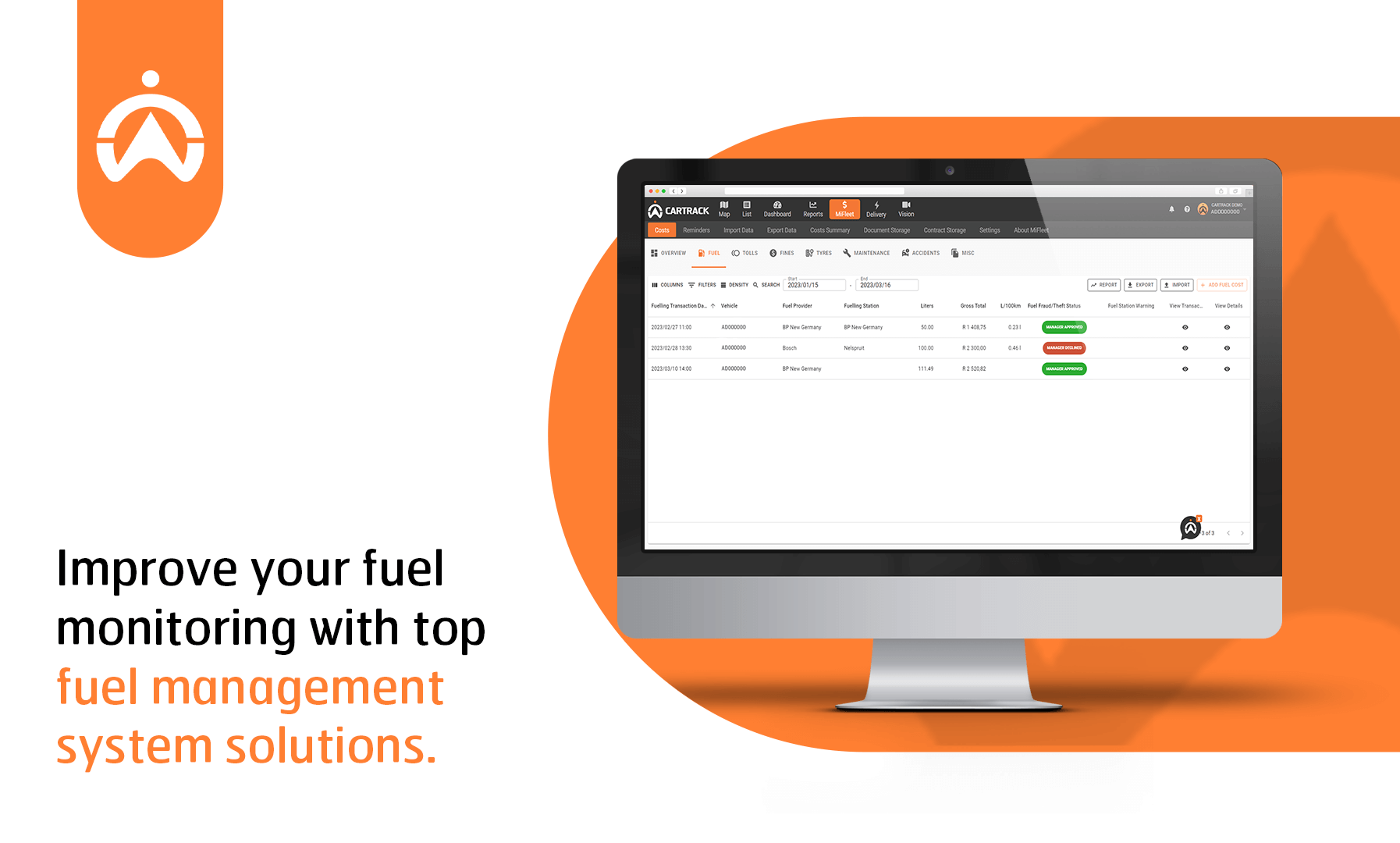
Control every cent with Cartrack’s fuel cost monitoring system. It reviews your fuel transactions and matches fuel receipts with your vehicle’s advanced telemetry data to identify any possible fuel theft,  saving you time, money and fuel. 

‍1 – Reduce fuel wastage

Be able to monitor your vehicle tank’s daily fuel levels. Also, know how much fuel your vehicles are consuming and the mileage driven, litres used per kilometre. This data helps you reduce fuel wastage and can be used to perform industry comparisons on driver and vehicle behaviour. If there is a sudden spike in fuel consumption, you’ll pinpoint the reasons such as it could be because of poor driver behaviour, fuel theft or your vehicles might need maintenance to be more fuel efficient.

2 – Spot fuel theft 

In many instances, criminals can manage to syphon up 125 litres of fuel at a time. Sometimes it can be hard to know if fuel syphoning is taking place, especially if your drivers will need to rest on long-haul journeys, which could create an opportunity for criminals to syphon fuel while the vehicle has stopped. 

If this happens, you’ll instantly know where, when and how much fuel is taken with live alerts so you can attend to the situation immediately before you incur excessive fuel costs. 

3 – Identify fuel card fraud

Our system automatically matches fuel receipts with the amount of fuel going into the tank. Fleet managers can check if the fuel they are paying for arrives in the truck’s tank, and not into another car. This will allow you to see your fuel purchase history and see which vehicles filled up at which station, and then you can match receipts accordingly. This will answer unexplained questions for fleet managers like “why was the fuel card used when the vehicles were not in use?” or “why were there excess fuel card transactions exceeding fuel budgets?” 

There’s telematic software solutions with smart algorithms that can be used to compare your fuel receipts and fuel card transactions to your vehicle’s data. This will help you spot any inconsistencies.‍

4 – Data reports 

The best way to assess fuel consumption is through data analytics and using the reports to make decisions instantly. Monitor your rate of fuel usage, through fuel level and consumption reports, where you’ll be able to see the total fuel consumed, fuel levels at the start and end of trips, average fuel consumption, refuelling, fuel draining events and more. Track usage trends and have the data on hand for reporting – receive the reports in your inbox immediately. ‍

5 – Insights into driver efficiency 

When you receive driver behaviour reports, you can determine which drivers in your fleet need to improve their driving patterns – which is another big contributor to increased fuel costs. For example, unnecessary and excessive idling contributes to an increase in fuel. An idling car uses between 0.76 to 2.65 litres of fuel an hour. An idling truck burns approximately four litres of fuel an hour. Driver training or coaching can then be provided to empower drivers to improve their behaviours, and prevent fuel usage from getting out of hand.

How does fuel monitoring work?

A fleet provider can install fuel level sensors directly into your fleet vehicle’s fuel tank, which will monitor the volume of fuel in a tank. 

Here’s how Cartrack’s fuel sensor system works: 

  • The fuel sensor (fuel filter) is installed into a vehicle’s tank by a technician to monitor fuel levels
  • The fuel sensor measuring system has one tube which is connected to the sensor
  • When fuel is added, it fills the tube and spaces around
  • After three refills have taken place, the sensor will be calibrated and ready for use 
  • Any decreases or increases in fuel levels will be accurately measured by the sensor
  • The sensor will send information about the level of fuel in the tank to our telematics system
  • The following data can be retrieved from our system; litres, vehicle location and tank capacity
  • All this data is transmitted to the Cartrack Malawi platform and can be compiled into reports
  • Alerts can be set up to monitor any fuel loss or gain and sent to you via email or sms

‍Why a fuel monitoring system for trucks is good for business 

  • Save on bottom-line costs

Fuel is one of the largest expenses in a fleet business, and with fuel costs so volatile, managers need to conserve every drop, going into their trucks, so they can keep business costs under control. Lack of fuel efficiency in trucks can impact productivity in a business, and negatively affect profits. For example, if you spend excessively on fuel, then you have less money to allocate to other areas of the business such as hiring more salesmen to promote your business. Or you might not have enough cash flow in your business, to cover unexpected expenses. 

  •  GPS tracking 

This is part of a fleet management solution, where you can see where your trucks are 24 hours a day, and if they are operating efficiently. You can assess how your fleet consumes fuel and driving behaviours that could be affecting fuel in real-time, giving you the opportunity to take action for any fuel inefficiencies. For example, you have two drivers on their way to the same destination, driving similar vehicles and one is using far more fuel – you can do something with this GPS data to avoid unnecessary current and future fuel wastages. 

  • Identify unsafe practices 

Telematics software can give visibility into unsafe driving practices. By monitoring the team’s on-road behaviour and highlighting poor driving habits, you can help correct dangerous behaviour and set targets for safety that will improve fuel efficiency in your fleet.

  • Reduce engine idle time

One of the main reasons for unnecessary fuel waste is leaving the engine running when the vehicle is stopped for long periods. A fleet management system helps to identify how long a truck has been idling, quantify the amount of fuel used, and notify the driver so they can reduce their fuel waste and unnecessary idling. 

  • Make fuel tax reporting simpler

If there is a significant spend on fuel, then admin tasks will increase especially compiling reports on fuel levies and taxes. Filing returns requires extensive information about when and how far trucks in a fleet have travelled that year, which the system will be able to provide. It may be difficult to keep track of all this information, but through the fuel management process, fleet managers can streamline the reporting of fuel usage for tax purposes.

Save on fuel with Cartrack Malawi

If you find yourself spending excessively on fuel and your vehicles are consuming more than they should, a fuel monitoring system will help tackle that. Take control of your fleet and solve fuel inconsistencies with Cartrack Malawi’s fleet management platform.

How Fleet Managers can Implement Effective Task and Team Management Tools to Boost Profits

Every fleet business needs task management in place, to make sure on-the-ground operations and tasks are up to speed. 

But often, fleet managers don’t know where to start.

Systems and processes make work easier, and with a fleet management platform, it’s even simpler – you have everything you need to manage tasks all in one place, and you can do it from anywhere. 

Imagine that. 

If you are looking for ways to manage tasks in your team or personal workload with one simple fleet solution, then you’re in the right place. 

What is task management and why is it important?

Task management involves monitoring all stages of a project and making continuous decisions until each stage is finished. 

Tasks will go through a life cycle of planning, testing, tracking, and reporting until completion. 

Effective task management is used by individuals, teams, organisations, and project managers who prefer to have a system in place to manage projects. It is a useful tool to ensure you meet deadlines, improve the quality of work, manage workloads, drive collaboration, and increase production.

The type of task management tools you choose will serve as a visual representation for the entire team and set the standard for organising tasks well. 

It will help you answer questions such as what tasks are being worked on? How many tasks have been completed? Are you on schedule with tasks or do you need some backup? And  when exactly you can close a project and start a new one with your team. 

Fleet software platforms offer task management features that can help you answer these questions, and manage tasks better in your fleet. 

What is an example of task management and where is it used?

The fleet management industry is an example of where task management tools and processes are needed, to run a fleet successfully. 

Often, managers have multiple drivers on the road at once performing various tasks like making deliveries. In this case, managers will need to make sure their drivers make deliveries on time, and keep customers updated throughout the process. They also need to meet deadlines for daily tasks and offer adequate reporting on each delivery task, its progress and achievements. 

Instead of manually calling drivers, sending messages, and monitoring deliveries using a spreadsheet, they can streamline their workflow and plan tasks on a platform like the Cartrack Delivery app. 

They can manage and assign jobs, plan routes for the day, track progress throughout deliveries, and drivers can also send updates on their progress, and accept or decline jobs. 

They can keep a record to indicate if they are reaching certain goals in their fleet, through daily customised reports. Perhaps, their goal is to do a certain amount of trips in a day to meet delivery targets and increase customer satisfaction, then they can access vehicle trip history reports.

On the fleet software platform, you can cut your admin in half because all the information about your fleet tasks is in one place, so for instance, you don’t need numerous spreadsheets relating to vehicle trip history for the month. 

Below are more insights about a fleet platform and some tips on task management that will help you move those tasks onto the done list.

5 ways to boost your business with task management, team management and work optimisation features 

  1. Track tasks more accurately‍
    ‍
    Use data to know if you are on track with your task goals and to make business decisions. A platform will give you all kinds of data reports you need. For example, perhaps one of your goals is to save on fuel, and you need to get your team together to solve this problem. You can pull up fuel reports and assess the data to see if fuel is dropping. You can use this tool to put a plan of action together to help save on fuel and find ways to cut costs.
  2. Manage your fleet remotely ‍
    ‍
    The more flexibility you have, the more tasks you can get done because you can monitor tasks no matter where you are. And with a cloud platform, you can access some sections of the platform from your phone and receive alerts for various triggers you’ve set up, to manage your fleet. For example, you can receive an alert to inform you when your vehicles are due for service.  
  3. Communication with your drivers‍
    ‍
    Assign drivers, vehicles, and jobs to complete and share relevant information or let them chat with you directly in real time, using the communication features on the fleet management app. This will help you optimise your operations, as you won’t have to try get hold of your drivers telephonically to assign jobs or communicate with them. For instance, a business selling fresh produce will get the orders in from customers, then can open the app, and calculate the best routes for drivers to take, and assign deliveries to the drivers strategically, ensuring on-time deliveries. Drivers can update their managers on where they are with orders from the app. Managers can then assign new tasks to available drivers and keep their customers updated.  
  4. Automated reports ‍
    ‍
    To make your fleet tasks increasingly efficient, a fleet platform can help you eliminate the amount of time you spend on admin. Cartrack’s fleet platform ensures your admin, operations, and finance teams have everything they need when they need it. There are various types of reports and insights a manager can download, automatically receive or have sent straight to his team to help make admin and communication easier. For example, if the finance team needs to calculate the fuel expenditure for the month, managers  can retrieve a fuel report on their fleet’s monthly fuel consumption levels and share these insights with the finance team.  
  5. Optimise your workforce ‍
    ‍
    Streamline processes in all areas of your fleet business, and remove unnecessary parts which will help improve your existing staff’s productivity and finetune certain fleet tasks. For example, with a fleet platform, you could make improvements to your maintenance procedures. You can retrieve timely maintenance reports and alerts to help you manage your maintenance schedules and keep your vehicles well-maintained. As a result, your staff won’t need to take the vehicles to the mechanics to be manually checked, and you will only need to service them when you get alerts from the platform, and with the knowledge from the maintenance reports – making this part of your business more optimised. 

What is the best way to manage tasks? 

Together with a fleet software platform, here are some other helpful tips a fleet manager can use to manage tasks even more effectively.  

  1. Focus on one task at a time ‍
    ‍
    Prioritising tasks is important to ensure the team isn’t doing more than they can handle, which could result in errors on projects. Bookmark important tasks for yourself so you know your priorities, and break big tasks into smaller subtasks, so the tasks can  get completed one at a time, and you can feel like progress is being made. This will also allow you to know who to follow up with, and you can tag individuals on tasks so they remain informed on updates as they happen. 
  2. Collaborate frequently ‍
    ‍
    Working in a team means more work will get done, but at the same time, everyone needs to be on the same page and in sync. You need to continuously communicate with your team about project successes and failures, and get feedback from them. You should create an open space for them to discuss their thoughts. Communication tools such as virtual workspaces or video conferencing programmes will assist with this so there is a constant flow of communication. 
  3. Realistic time frames ‍
    ‍
    Each task should have a realistic timeframe, and deadlines according to the relevant importance of the associated task or activity. Every timeframe you set should be achievable to help avoid unnecessary stress within your team. Keep your task list organised and ensure that your team is given enough time to complete tasks. 
  4. Define roles and allocate resources‍
    ‍
    Assign the appropriate people with the right amount of experience and resources to get the job done. Every one of your team members should know exactly what they are supposed to do, this will also help build accountability within your team and keep everyone focused on the task at hand, which will improve productivity levels. 
  5. Goal tracking ‍
    ‍
    Defining milestones helps motivate teams to execute tasks successfully. You can keep track of tasks using a reporting tool. Modern-day reporting tools come with features like project reports, resource reports, and time reports. This will give you a clear idea of everyone’s efforts, how things are moving forward, and how team members are utilising their time. 

Let’s unpack why task management software platforms are so important for you and your business. 

Five key benefits of using task management software 

  1. All tasks are in one place ‍
    ‍
    If you find yourself scrambling to find tasks and you have multiple spreadsheets, a software platform will help you organise and keep all your tasks in one place. For example, a fleet software platform has a customisable dashboard with multiple tabs which ensures that all your fleet information and task progress is in one place. This helps you save time from having to search for information and keeps your team on schedule because you can quickly delegate and track tasks, from anywhere. 
  2. More control for managers ‍
    ‍
    An organised platform eliminates some stress and pressure for fleet managers, project managers, and business owners because they have an overview of all tasks and can attend to other tasks – essentially multitasking. This is particularly useful when they have meetings, report backs, and are solving daily problems, they won’t need to worry about finding the data they need or waste time on unnecessary admin. 

    For example, say there is fuel syphoning happening in real-time, and fuel consumption levels are abnormally high, a manager can immediately intervene. They will be able to see from the fleet platform, which vehicles are consuming more fuel than others, flag areas of concern and investigate these.  

  3. Room for business growth‍
    ‍
    A fleet platform can help you make the customer interaction with your business more seamless and efficient, as you are able to communicate with your customers about their deliveries. The efficiency factor also allows you more time for your customers, this could include answering queries more, regular check-ins, email updates, and going the extra mile for them.   

    You can also focus more on sales and marketing opportunities to grow the company or offer lower prices, more products and services because efficiency opens up more cash flow.

  4. Important for remote work trends ‍
    ‍
    Businesses that fail to keep up with technologies and software systems, can fall behind their competitors, and disconnect from their customers.

    An example of this innovation is an increase in remote work globally. Companies are needing to adjust accordingly with better communication systems or run the risk of poor work ethics which can lead to frustrated employees and customers.

    A remote work statistic of 2022 is that 56% of companies around the world offer remote work opportunities. However, 88% of remote workers face inconsistent leadership and miscommunications with other team members, says Saaslist. Task management software can help bridge this gap. 

  5. Increased team productivity ‍
    ‍
    According to Saaslist, project management and online task management software saves the average employee 498 hours per year. There is more streamlined communication to prevent less back and forth between managers and staff. Companies could also save on business costs, as they might need fewer employees, as a result of an improved and streamlined workflow.

7 additional task management tips every manager can use

If we look at managing tasks holistically across the board, the principles of organising are the same. 

Here are some methods you can look into to help you make your fleet successful. 

  • Do the challenging tasks first‍
    ‍
    This involves starting with the harder tasks at the start of the day when you are more energised, before moving to the easier tasks. This will give you more time to make changes, research, and ask questions for challenging tasks, and you’ll feel more relaxed for other tasks.
  • Task boards‍
    ‍
    Create your board or use a task management software platform to organise project management tasks into three categories: to-do, doing, and done. You can then sort your tasks into their respective categories so you can track your progress. After you finish a task, you can move it over to the “done” column to identify the tasks you’ve accomplished. When you see tasks completed successfully, it will motivate you to complete more. You can further categorise and organise tasks by using colour coding.
  • Simple lists ‍
    ‍
    This is a more straightforward way of organising tasks, by simply writing tasks on a list, putting their due dates next to them, and then ticking them off the list once you complete the task. Just make sure you write your list on something that won’t easily be misplaced or thrown away. 
  • Rows and columns ‍
    ‍
    Organise projects using a spreadsheet and place specific projects in their respective columns, then list the action items required to complete each task. This helps you better visualise how much work and time you need to put into finishing certain projects. Listing the individual tasks underneath each project can also make it feel more doable and approachable.
  • Task timer‍
    ‍
    To assess if you are spending the right amount of time on tasks, you can split your tasks into sections of around 25 minutes of uninterrupted time. Stop once the timer alerts you, take a break, and then return to the next task. Some tasks might take up the full allocated time or less, and you can adjust accordingly. This technique allows you to do many tasks and keep productive while giving your brain a chance to relax. It will also allow you to assess what tasks take longer than others, so when you are planning tasks, you can create an appropriate working schedule for ultimate productivity. 
  • Be open to feedback‍
    ‍
    This is one of the most important project management tools and strategies as there is always room for improvement. You need to keep informed about what’s working and what isn’t. Feedback is a two-way street. As a manager, you need to give feedback but also get it back. This will ensure project objectives are met timeously. It will also create a space for a good flow of communication, giving team members clarity on what needs to be done at all times.

Manage your tasks easily and efficiently with one platform 

Overwhelmed with tasks, deadlines, workflows, admin, paperwork, and have a team to manage? Whether your business is big or small, our system will help make your daily operations a whole lot easier.

Easily manage tasks, track progress, collaborate seamlessly, and have everything you need to successfully manage your fleet, all from the Cartrack Malawi platform. 

How to stop vehicle idling and save fuel and business costs

Is idling bad for your car? It sure is. Now imagine if you have an entire fleet idling, it surely will put a dent in your business’s bottom line – and quickly too.

Whether drivers leave the engine running while unloading deliveries, stuck in traffic, taking a roadside phone call, warming up the interior in the winter months or cooling it down in the summer, every second of idling costs.

This is how idling vehicles in your fleet costs you, and we’ll give you ways to cut down on idling and save.

What is vehicle idling?

Idling is when a driver leaves the vehicle engine running when the vehicle is parked. Every day millions of cars and trucks idle unnecessarily, which can have many implications. 

What is an example of idling? 

This could be in stop-and-go traffic, drive-through lines, or loading docks. As well as running the vehicle to power heating, air conditioning, and electronic devices. 

If you are a fleet manager with multiple drivers and vehicles, you’ll want to keep tabs if they are keeping your vehicles on for aircon, offloading while the engine is on, or idling too much in traffic.

So, what is the problem with idling? 

Idling for more than 10 seconds uses more fuel and produces more emissions, contributing more to smog and climate change than stopping and restarting your engine does. Idling also contributes massively to the general wear and tear of a vehicle, a lot more than you’d imagine. 

Let’s dive into this a bit more. 

What is vehicle idling?

How does an engine idle?

On a modern fuel-injected engine, the engine idle is controlled by the engine control unit (ECU) and electrically operated by a simple throttle stop, known as an idle screw. This screw stops the throttle linkage arm from completely shutting the butterfly valve that allows air to enter.

The throttle stop allows the butterfly valve to sit slightly open, which will then let a minimum amount of airflow reach the combustion chamber. This opening is just enough to allow a specific amount of airflow through to keep the engine running when there is no physical throttle input from the gas pedal. 

Then there’s the idle air control valve or IAC valve, which uses sensors that communicate with the ECU to adjust airflow into the engine to achieve the desired engine speed at idle.

This is something to look at next time you think of warming up the engine. 

5 reasons to stop your car from idling

  1.  Less wear and tear on parts

An hour of idling daily adds up to around 102 998 km of engine wear over a year. And that’s just for one vehicle.

According to the American Trucking Association, such wear can increase maintenance costs by almost $2,000 per year and shorten the life of the engine.

The reason is that excessive idling puts a huge amount of stress on your car’s parts. An engine running at idling speed causes twice the wear on internal parts compared to driving at regular speeds.

How does idling harm vehicle engines and systems? 

Idling can cause fuel to wash away the oil which lubricates the motor, causing friction that ages the engine prematurely. Modern engines have fuel consumption regulating sensors, and idling doesn’t warm the engine well enough to enable the sensors to respond, as the fuel-to-air ratio is too rich. Partially combusted fuel can damage engines, spark plugs, and exhaust systems.

A software platform provides driver scorecards that can help increase your vehicles’ lifespan, by decreasing bad driving habits like idling, reducing accidents, and boosting your operational efficiencies. This fuels smart business overall. 

No matter the size of the vehicles in your fleet– parts and maintenance aren’t cheap. You could be using money spent on repeated repairs elsewhere, to grow your business and expand your resources.

  1. Limit health risks

Idling creates the same amount of pollution as when the car is moving. These pollutants have been linked to negative health implications and diseases including asthma, heart disease, chronic bronchitis, and cancer. 

Some studies have even reported that acute exposures have resulted in hospitalisation due to respiratory conditions while cardiovascular health conditions result from chronic exposures to pollution. 

In addition, when sitting in an idling vehicle, there is no air flow to vent the emissions. Therefore, fleet managers should also take measures to stop idling for their Drivers’ health, as they will be exposed to vehicle pollution more so than when the vehicle is moving. 

  1. Protect the environment

According to a recent Convoy survey, reducing carbon emissions remains a critical concern. In 2022, 38% of dispatchers, drivers, and owner-operators feel pressure to reduce carbon emissions in their businesses — a 3% increase from 2021. 

Research by the U.S. Environmental Protection Agency found that transportation produces 29% of U.S. greenhouse gas emissions, the highest of any sector. 

For every 10 minutes your engine is off, you’ll prevent one pound of carbon dioxide from being released (carbon dioxide is the primary contributor to global warming). 

One wasted litre of combusted diesel fuel throws 2,64kg of CO2 into the atmosphere. 

  1. Save on fuel costs

An idling car uses between 0.76 to 2.65 litres of fuel an hour. An idling diesel truck burns approximately 4 litres of fuel an hour. One of the most impactful ways for trucking companies to create sustainability is by using less fuel. Taking measures to drive fewer miles and reduce idling is a way to reduce fuel consumption idling, and thus save on costs. 

Cartrack’s smart dashboard on the software platform shows you how much fuel your fleet uses for unproductive idling. 

  1. Cut business costs 

As mentioned, idling increases maintenance costs for general wear and tear, as well as additional fuel expenditure.

This will have a direct impact on your bottom line, and overall business profits. 

5 reasons to stop your car from idling

 4 ways to reduce vehicle idling with a fleet platform

  1. Driver behaviour reports 

A fleet management platform provides data reports about driver behaviour such as idling, rough driving, speeding, braking, and cornering. If excessive idling is identified, then fleet managers can implement actions to stop this from happening.  

The software reports can also show you which drivers are idling longer than others, so you can notify these drivers accordingly. 

  1. Educate and motivate your drivers

Some people believe restarting the vehicle burns more fuel than leaving it idling, and your drivers could be among them. 

According to the Environmental Defense Fund, idling for 10 seconds wastes more fuel than restarting the engine. 

Debunking these beliefs will encourage your drivers to switch off their engines whenever the vehicle is stationary for more than 10 seconds.

When it comes to fleet management, standard operating procedures for engine idling must be part of a training programme and safety culture. 

Fleet managers should teach drivers about engine idling impacts, and how to avoid idling– to help build best practices at the onset. Ultimately, it will motivate and empower them to improve their driving.

  1. Optimised routes 

By analysing the data provided, you can track where the most idling is taking place and why, and optimise your routes to prevent this.

Traffic congestion is another main cause of increased idle time. 

You can use telematics software to optimise your drivers’ travel routes to avoid heavy traffic where possible, thus reducing idling. 

Cartrack Delivery’s route optimisation feature uses GPS and algorithms to evaluate all the possible routes for drivers to take. The telematics software assesses multiple variables when determining the best routes, including current traffic, accidents, and roadblocks. 

Drivers can adjust their routes in progress or before they start their trips. 

  1. Geofencing

You can use geofencing to reduce the time your truck idles, by putting a geofence around common idling areas. When one of your vehicles enters the geofenced area, the telematics software will send you an alert to show how long the vehicle remains in the area.

Idling on a construction site as an example

It is common for heavy-duty equipment on construction sites to spend significantly long periods with the engine idling, due to the nature of the work– and more than necessary. In these cases, idling should be monitored with the help of idling insights from a fleet platform. Fuel is one of the largest expenses for heavy equipment and vehicles in the construction industry, which is more of a reason for it to be kept under control.

Idling on a construction site as an example

 Save on the fuel and running of your fleet today

Idling can be an expensive problem for your business, but there’s a simple fix. While making drivers aware of more cost-effective habits goes a long way, our GPS and fleet vehicle tracking software can help limit idling.

What’s more? A customisable software dashboard helps you easily monitor other key metrics that matter to your business. Improve your fuel consumption, idle rates, driver safety, fleet running costs, productivity, vehicle usage, and more.

Contact Cartrack today to find out how our expert fleet management solutions can help, as well as the latest fleet technology trends.

Why starting a transport logistics business and trucking company will benefit you

Truck logistics play a significant role in our economy and daily lives.

According to the Commodity flow survey (CFS) trucks transported 71.6% or $10.4 trillion of the $14.5 trillion worth of all goods shipped in the United States in 2017. Clearly, starting a truck logistics business comes with a lot of rewards but it is hard work too. 

What is logistics and how has it evolved to truck logistics?

The word logistics originates from the French term loger or logistique which means shortage. Historically, logistics was a term associated with the military where the function of logistics was supplying troops with suitable equipment for war. 

With the rise of consumerism and the growth and complexity of supply chains, the word logistics evolved in the 1950s. Logistics became a term used in the business sector to refer to the process of planning, implementing, and controlling the transportation of goods, resources and information from the point of origin to the point of customer consumption. The focus of logistics shifted from the war to meeting customer expectations and reaching customer satisfaction in the most timely and cost-effective manner. 

What is logistics and how has it evolved to truck logistics?

Today, the industry logistics markets have further developed as a concept that is utilised for business analysis and planning to help businesses achieve strategic competitive advantage by considering all possible factors involved in the business operation.

Truck logistics, therefore, refers to the research and planning of trucking operations. The logistics of trucking take into consideration all the factors involved in the transportation of goods and resources with the use of trucks, to boost productivity and efficiency. Trucking logistics include: 

  • Planning and optimising the most efficient routes for truck drivers 
  • Improving fuel consumption through fuel management 
  • Ensuring trucks are in good condition to complete tasks
  • Hiring an excellent staff of truck drivers
  • Applying effective fleet management 

In today’s industrialised world, trucks are one of the primary means for commercial transportation and the transportation of goods. Efficient trucking logistics not only helps a trucking company achieve success but also contributes positively to the economy. It is therefore safe to say that the trucking industry plays a large role in the economy.

Let’s take a closer look at how this important and large industry operates.

How does the transport business industry work?

A truck logistics company falls under the transportation business industry which is made up of businesses that transport goods, resources, or even passengers from one location to another. These businesses provide services to different target markets, from individuals to companies and even global trade partners. This means that businesses in the transportation industry can specialise in various niches and activities from e-hailing or hauling customer goods to international shipping of supplies and products. 

Businesses in the transportation industry are commonly classified into different categories based on their target customer, the type of routine, and the service provided, namely:

  • Personal transport: This is catered to individuals and small groups of people and includes one-on-one services such as taxi services, bus services, and most recently e-hailing services. 
  • Local transport: This category provides services to regional markets by transporting cargo such as livestock, materials, consumer goods, and more. Local transport may be commercial or private, depending on the distributed materials. 
  • Global transport: Global transport offers services for sea shipping or air-based delivery of cargo. These services consist of aspects of the personal and local categories but on an international scale.

Truck logistics focuses on local services. In providing these services, truck logistics prioritise road safety to ensure the secure transportation of cargo and the safety of both truck drivers and individuals as well as the preservation of specific goods, products, and loads. 

What trucking logistics does is examines factors such as trucking routes, types of loads and delivery times to best facilitate the different types of transport services and determine the best means of transport. For example, heavy hauling and long hauling are more demanding aspects of trucking than e-hailing personal services. 

The role of truck logistics in transport supply chain businesses

A supply chain refers to a network of individuals and companies who are involved in creating a product and delivering it to the consumer. Truck logistics is an aspect of the supply chain that plays a role in delivering goods or services to customers, manufacturers, distributors, or consumers. 

Simply put, the supply chain covers the production and distribution of goods and services to all types of customers while truck logistics focuses on the movement and storage of products in the supply chain. When efficiently implemented, both supply chain management and truck logistics work together to give companies a competitive advantage and bring value to their customers.

The goal of truck logistics is to get goods and services delivered on time. To achieve this goal, truck logistics follows a logistics flow that entails the movement and direction of goods, resources, products, or information within a supply chain network between the point where the goods, resources, products, or information originate to where they are consumed by customers. 

The three types the logistics flows are:

  1. Inbound logistics: Raw materials, tools, machines used for manufacturing, consumable items needed for fuel, or various spare parts and other elements for production inputs are moved, transported, or stored from suppliers to manufacturers for processing and production. Being the first stop of the supply chain, effective inbound logistics allows for a swift and integrated supply chain.
  2. Outbound logistics: Finished products from manufacturing are moved to the next stop of the supply chain. These finished products are shipped and delivered from the warehouse to the logistics business customers. All the products that move through this outbound logistics flow are intended for consumer consumption and satisfaction- this is also referred to as the order fulfilment process. 
  3. Reverse logistics: This involves returning, servicing, repairing, refurbishing, reselling, recycling, recovering, or properly disposing of products. Reverse logistics, therefore, refers to moving items or goods from the consumers back through the supply chain. This process is most common in the automobile and electronics industry.

3 reasons why you should start a trucking company

With the current shortage in the logistics industry, starting a truck logistics business can be rewarding. Here are three reasons why you should start a truck logistics business: 

  1. You can make money

Amongst other reasons, people start businesses to make money. So yes, you can make money from a truck logistics business, however, only if you manage it efficiently. This is because the profit made in the trucking logistics business is heavily affected by the costs. Fuel costs are one of the factors that can lead to high costs, especially in trucking and logistics- fuel costs eat up your profits. 

  1. You can work from home

Working from home has become a new norm. Today, the basic needs of managing a truck logistics business are a computer, phone, and internet. With these gadgets, starting, owning, and managing a truck logistics business from home is possible. Trucks can be busy on the road all day while you use fleet management software to monitor the activity of your fleet with the use of GPS location software. 

  1. You do not need to own trucks 

Most people have the assumption that to start your own trucking business you need to invest in a truck or trucks- this is not the case. As an owner of a truck logistics business, you do not need to be the owner of the truck or trucks. A start-up trucking business can be started with another person’s truck- just like Uber and Bolt. This is called an owner-operator and you can simply register the owner-operator’s truck under your authority. 

Thinking of starting your own logistics company? Let’s get you started with the following steps!

 6 actionable steps to plan and start a truck logistics business

  1. Complete the required training

Truck logistics requires the right set of training and skills, therefore it is important to acquire the right training suitable for the job. The form of training will vary based on the type of service the trucking business will provide- whether global, local transportation, or both. The following are some of the training requirements:

  • Transport Management Systems: This training gives an understanding of how transport management systems (TMS) work and why it is vital for transport systems. The training equips you to manage and track all the different aspects of transport management such as vehicle maintenance, warehousing, communications, cargo handling, and more.
  • Management and Inventory Operations: The ability to handle and control inventory plays a vital role in the transport and logistics business. Inventory management is integrated with warehouse management to inform and educate you on how products move through your operation.
  • Transportation Regulations and Law: To run a trucking logistics business that provides both domestic and international services, training should include regulations on interstate commerce and global shipments and carriers.

There may be additional training or courses that may have to be acquired depending on the type of service your truck logistics provides and local government regulations. 

  1. Do your research

Before you get into truck logistics it is important to research the industry. Research helps you understand the business and how viable it is, even before entering the market. Here are some research points that could give you an overview of the business: 

  • Costs: As mentioned above, the purpose of owning a business is to make a profit. It is important to find out the costs of the business and whether the business is profitable. 
  • Competitors: Researching competitors will help you understand what other service providers are doing right or wrong. This way, you will gain an understanding of what the customer’s expectations are.
  • Niche: The truck logistics business is a big industry. Find out what goods and services you would like your business to specialise in. Successful businesses pick a lane.
  1. Set it up

Starting a truck logistics business will take a lot of time, money, and energy, this is because it involves planning, making key financial decisions, and completing a series of legal activities. Here is a guide to setting up your truck logistics business: 

  • Create a business plan
  • Choose a business entity
  • Open a business account 
  • Ensure fleet compliance
  1. Get funding

Transport tools and different road and cargo shipping requirements are some of the capital needed to start a track logistics business. Therefore, you need start-up capital to start a truck logistics business. Luckily, there are many funding and financing options accessible, based on the type of service a truck logistics business provides as well as the geographical location of the business. There are traditional financing options such as loans and private financial aid. However, if you have no money, you can opt for financing that can help you start a trucking logistics business with no money. The trick is doing the research and finding the funding that is ideal for you. 

In Malawi, truck logistics presents a major business opportunity with a few good funding options- these include both government funding options as well as private funding. 

  1. Put together a team to operate your fleet

A truck logistics business without truck drivers is non-functional. There are many things to take into consideration when hiring employees: 

  • Do they have a history of safe driving? 
  • Check the applicant’s compliance, safety, and accountability profile (CSA)
  • They must have a commercial driver’s licence (CDL) or road test certificate
  • Make sure the applicant’s medical certification is up to date
  • Have a road test

Finding a suitable employee will take a lot of time and effort but hiring the right applicant for the job will positively impact the business. 

  1. Invest in fleet management software

Finding the best fleet management software will help you ensure the success of your business. A good fleet management software will help you optimise routes, track truck drivers and cargo, ensure your fleet is compliant, help you manage fleet-related costs, protect you from fuel fraud and ensure you keep your truck drivers safe. 

Oversee your logistics company and save time with Cartrack’s software as a service (SAAS)

Cartrack’s fleet management software allows you to streamline your entire fleet operation from monitoring driver behaviour and using GPS tracking to pinpoint drivers and assets to managing vehicle usage and fuel usage.  

Contact Cartrack today and kick-start your successful trucking company with us. 

5 top actionable business insights for your fleet

The process of data collection is more than meets the eye. When cracked right, there are multiple ways businesses can use it to their advantage. 

 It starts with analysis, followed by objective-based interpretation, and ends with opportunities for business development and exploration.

 In this article, we’ll take you on an insightful data mission, where you will get the chance to achieve actionable business insights through data.

 We are here to empower managers and unleash their decision-making powers. 

Actionable business insights through data

How-fleet-management-helps-with-your-vehicle-maintenance

The data process can seem like quite a mouthful, but let’s break it up into bite sizes. 

 Data is the information that you collect from your systems. For example, in the fleet management process, you might need data about driver behaviour, fuel consumption, maintenance alerts, and much more. 

 Insights are the value you derive from the analysed data. You can use data analytics to identify trends and patterns in the information retrieved. Analytics assists to make sense of the data. 

 Information is a product of refining this data and giving it structure and context. This way, you aren’t staring at a bunch of random numbers on spreadsheets and documents. 

 Actionable insights are where the magic happens. This is the part where businesses use data analytics and discoveries to take action and improve the efficiency of their operations.

 There are many online tools available to make sense of data. In the fleet vehicle tracking industry, software platforms are trending. The advanced tech is already in place, with powerful insights, and integrated analytics – all designed to give you the reports you need.

 Let’s dive in a bit more.

What are actionable insights examples? 

How-Cartracks-fleet-management-delivers-actionable-insights

Fleet management systems or platforms are what fleet managers can use to achieve and harness actionable insights.  

 These are accompanied by advanced software technology assisting businesses in developing a strategy to make informed decisions. 

 You could choose Cartrack as a provider and gain actionable insights such as:  

  • Instantly pinpoint challenges. This will allow you to make changes immediately during work hours and in your business overall. While you are quickly putting fires out the business can keep growing with increased productivity levels.
  • Receive contextualised metrics. Perhaps you want a specific context for a certain reporting requirement, such as the cost per job. The operational, administrative, and financial data costs can be aligned for you to analyse this spec. Receive metrics for all three and can determine the exact cost per job, and make price comparisons. Maybe one outweighs the other creating a cost imbalance, so you might need to make some cost changes there. Also, compare accurate metrics to see whether your routes are optimal and know how other costs impact your margins.
  • Use comparable metrics. Compare metrics across drivers and vehicles to pinpoint price differences in costs per task, or differences in behaviour and maintenance costs for the vehicles they are driving. If one driver’s vehicle is costing significantly more on maintenance than others, managers can assist their driving behaviours and empower them where needed. Use this to assess driver productivity. Know how much time your drivers spend on the road and how many jobs they complete in the required time.
  • Get important insights instantly. There might be an urgent concern that needs your immediate attention, prompting a meeting with concerned parties. Say you don’t have time to spend hours analysing data; the platform will give you a visual overview of your fleet’s fuel consumption, unproductive idling, safety, and utilisation on the dashboard, all with one click. You can filter data by time or vehicle for added flexibility and speed in pinpointing challenges. With this, you can be prepared for your meeting without doing much prep.

What are data insights for business decisions? 

Data-insights-deliverd-through-cartarcks-fleet-management

We know that actionable data can help you make immediate moves and business decisions.  

 However, we should expand on it, ultimately using it in the best way possible for the business. In other words, use it to drive workforce optimisation, which encompasses admin together with task, team, and change management. 

 Fleet owners need a solid business structure and strategy behind them to set the foundation for fleet managers, drivers, and all other staff. From there, we can create meaning out of insights. 

 But let’s start with the base first.

Actionable insight business considerations

  • Get the right people in your corner

‍It’s important to hire the appropriate people for the job who can understand the data insights. Investing time and energy into finding the wrong people is costly, and not just financially, but for the business flow. For example, fleet managers should be hired based on the fleet experience they have to understand what the system data means. 

  • Communication and team planning

‍The importance of communication and planning for businesses and teams has proven to be one of the most important task management strategies. With a vehicle fleet, it goes without saying that you will have a diverse team, often distributed all over. As a result, you need to plan, manage, follow up on tasks and create a space for them to excel. One way of doing this is having communication channels in place to improve driver productivity and ensure efficiency. Fleet software apps offer this feature. 

  • Set up KPIs

‍These are used to assess an organisation’s performance against its goals. They aid in decision-making, assist in setting strategic objectives, and enable effective processes. This will motivate employees and assist with their performance. 

  • Internal actions

‍Managers and teams need to create actions within their task management, and delegate tasks to team members. Reminders are set and updates are done, once the task is complete – they can move on to the next. This is also part of the communication channel chosen.

  • Competitive advantage 

‍Companies should capture, manage and analyse their data to improve their business intelligence. They can then grab the opportunity to jump ahead of competitors by offering great customer service.

How do you convert data into meaningful insights?

Actionable-insights-brought-to-you-through-our-fleet-management-system
  1. Define your goals and objectives 

‍Before even choosing appropriate fleet management software, goals should be top of mind. Goals give everyday tasks more meaning and clarify the reasoning behind company decisions. Without these in place, there isn’t much to work towards causing stagnation and struggle to make accomplishments. Goals are steps to the end result, which are part of every business plan. 

Fleet managers can set operational goals such as saving on fuel costs and improving driver engagement. With this in mind, they can go directly to the part of the platform that gives this insight. Maybe the marketing team’s goal is to bring in more leads for the business, which will require a higher budget. Saving on fuel costs and working towards that goal, will directly bring in more revenue for the company. 

If this does come to fruition, the data indeed will be a meaningful insight that can be measured to the goals.

Now, you will be able to ask the right questions and figure out what questions you want your data to answer. Before you unravel the data, it will ensure that you don’t spend time on the wrong things.  

  1. Segment your data 

‍Cutting up data into segments can help you make better sense of it. A fleet software platform works in the same way as Google Analytics. You can customise the platform to suit your needs, and pull up the specific data you require for adequate reporting. For example, maybe you have a management meeting about driver behaviour and productivity. You can create a segmentation for that on the platform, and then relay feedback on that only. 

  1. Use visuals to simplify data sets

‍Visuals are a nice way to represent data in an easily comprehensible manner. Especially when it comes to presentations, you cannot use raw data to relay information, but should rather use visuals to show your findings. The software’s report function will be the starting point before you create the perfect presentation for your meeting. 

  1. Discover the context

‍Without the right context, you’re either not getting the full story or getting the wrong one. Based on your pre-determined goals, you need to get the full picture to create meaning out of the outcome or visuals. You should ask questions like who is responsible for this within your fleet? Or why did it happen? And in what way does it affect the business?

  1. Spot the right patterns

‍Up, down and zig-zags in between, this is what you commonly see on visual representations. From this, you can determine patterns or trends in the data concerning certain incidents. You can identify when there is an upward or downward trend, visualise a relationship between two factors, and more. They’re all tailored towards uncovering the stories behind the data. 

  1. Determine a hypothesis and action plan

‍You’ve done your research, now is the time to get going with an action plan. Perhaps, vehicle maintenance issues are the common trend of driver misconduct. Maybe you need to delegate this issue to more team members to resolve, where they will dissect this reporting feature in more detail. 

6 key attributes of an actionable insight

Actionable-insights-for-your-business-through-our-fleet-management

We understand that you could be on the move a lot. Want a quick rundown of how to achieve actionable insights? Whip these out and take action.

  1. Alignment

Tie your insights to defined business goals to drive action. Align them with your KPIs to create urgency.

  1. Context

You need background information or comparisons to give data insightful context. Otherwise, there will be more unanswered questions rather than a plan.

  1. Relevance

Deliver the insight to the right person at the right time and setting. They need to reach key decision-makers for appropriate action to take place.

  1. Specificity

If you are highlighting actions, then you need to explain them in detail for people to understand. Explain why something happened to develop more action.

  1. Novelty

Give interesting insights. There’s no need for repetitive insights but rather to give new developments to create more growth and challenges. We switch off to information if we feel they constantly reinforce, rather than challenge and increase our current knowledge.

  1. Clarity 

Insights need to be clear to understand. People need to understand the reason behind it and how it will help them. Visualisations will help the information stick.‍

Conclusion 

Need some meaningful insights? With Cartrack, there are hundreds of reports to boost your business. Speak to us today and receive automated reports to match your workflow straight in your inbox. 

7 ways you can drive to save fuel

With the general cost of living on the rise, be it fresh produce or monthly rent, the recent petrol price spike is beginning to seem like a stretch too far for many. Although we can’t bring the petrol prices down, we can give you some fuel-saving advice that could help keep your wallet a little fuller each month.

For many of us, saving money and drafting a budget doesn’t come naturally. Most often, we end up spending the money we initially saved. Well, don’t stress, we are going to unpack a few ways you can burn fewer fumes and save more cash. 

We know millions of South Africans are feeling the pinch at the petrol pumps. That’s why Cartrack is giving motorists something to smile about. 

#ExploreMore with Cartrack, sign up and stand a chance to win your share of R25 000 in petrol vouchers. While you think about that, here are some free fuel-saving tips you can put to the test the next time you’re out on the road:

How-safe-driving-habits-can-become-a-fuel-saver

1. Drive like your petrol depends on it

Keeping your engine on while your vehicle is not moving is not advised, here’s why: Idling while driving burns an unnecessary amount of fuel and puts additional stress on some parts of your vehicle that could become damaged as time goes by.

Contrary to popular belief, continuously switching your car on and off while stuck in traffic, does not burn more fuel than leaving it idling, in fact, idling burns more. We elaborate on this in more detail in another article that explains how turning off your engine when not moving for longer than 10 seconds can be a simple fuel-saving solution that also saves on business costs.

2. Don’t speed

Sure, this activity may feel like you’re getting from A to B faster, but speeding is one of the biggest contributing factors to rapid fuel consumption. Simply put, vehicles naturally use the most energy when accelerating.

If you are serious about getting the most litres per kilometre, we recommend you leave the bad driving habits like speeding, abrupt acceleration and braking, for the race track and stick to the rules of the road. Exercising safe driving and driving the recommended speed limit, especially on long-distance roads, will improve your vehicle’s fuel economy drastically.

3. Change gears smartly

If you have a manual gearbox, switching gears too early may be another reason why you find your fuel light turning on empty a lot sooner than you expect.

Not giving your vehicle ample time when changing gears from a higher gear to a lower one will increase fuel consumption and engine strain as the engine is still continuing to run at a higher rpm while shifting into a lower gear, making the engine work harder than it should.

To help lessen the load on your engine, keep your revs per minute low while cruising, preferably between 1500 and 2000 rpm, and below 3000 revs while accelerating on a highway. This will provide you with the optimum fuel efficiency for your engine.

4. Check your tyre pressure

Believe it or not, the state of your car impacts your petrol usage. Being up to date with servicing your car and frequently checking on its maintenance are good habits to have if you hope to save on petrol.

Underinflated tyres take up more space on the road, causing them to drag while driving. This increases resistance and fuel consumption as you continue to use them.

Depending on your manufacturer, you can typically find the recommended tyre pressure on the inside of the door or in the manual. For low-rolling-resistance tyres, you can have the pressure pumped up to 0.3-0.5 bars above the recommended level for a smoother ride.

5. Make shopping an all-in-one experience

Another smart way to make every drop in your tank count is to make shopping a “one-stop-shop”. Imagine this, you’ve finally finished your long day at work and are about to head home. You get home, open the fridge and realise you’re all out of ingredients. Before even putting your feet up, you’re already out the door, heading to the shops.

Next time, head to your local shops on your way home and buy whatever you need. Simply planning your trips or routes before heading out can help you avoid burning unnecessary fuel.

6. Carpooling

“Hitching a ride,” or more commonly “carpooling,” is the next big thing when thinking of sparing your own petrol. According to Business Tech, carpools and lift clubs are South Africans’ go-to options for beating record-high petrol prices. 

Besides saving money on fuel costs, alternating lifts let you sit back, relax, and listen to music while you’re being driven around town. If more people started carpooling, fewer cars would be on the road, traffic would be greatly reduced and air pollution would slowly decrease. 

Carpooling also helps to prolong the life of your own vehicle, as your monthly mileage will be significantly reduced. Although this fuel-saving method is very popular, it could have an impact on insurance premiums. 

For instance, if you’re the designated driver and you receive payments that exceed just the petrol and parking costs, your insurer could view this as a commercial transaction and require you to switch to business insurance or obtain a special permit for carpooling.

7. E-hailing

If you don’t have a group to drive with or simply don’t enjoy the company of local strangers, then e-hailing services might be for you. With e-hailing, you don’t have to worry about how much petrol you have left or putting extra wear and tear on your own car. You just open an app, order a car, wait for the driver and enjoy the ride. 

These days, there are multiple e-hailing apps to choose from, including Uber, Taxify, inDriver and many more. All these services offer different pricing on rides and offer their own special discounts on their respective mobile apps from time to time.

Save-fuel-by-implementing-safe-driving-habits

Fuel positive helper

There’s also technology out there that can help you monitor your vehicle’s fuel usage. You can track how much fuel your fleet or vehicle uses every day with Cartrack’s smart dashboard. By analysing the data provided by the devices installed on your fleet or everyday vehicles, you can learn where fuel is consumed most and why.

Cartrack can also calculate the safest and fastest route you should take when driving, so you don’t have to burn extra unnecessary fuel getting to your destination. Visit us today to start saving on fuel.

Optimise Maintenance for your Fleet

Cartrack’s fleet management system tracks your service needs based on the kilometres that your vehicles have driven and alerts you when a particular vehicle needs service. Service alerts can help save fuel and reduce your maintenance costs at the same time.

Here’s why this system is so beneficial:

  • Using automated maintenance alerts can help you ensure that your vehicles are maintained and remain in peak condition
  • You can set up automated alerts for service reminders
  • You can schedule reminders and keep a recorded  history of past services